
I’ve always believed that marketing should feel seamless. The best campaigns are the ones where the moving parts all run in sync. This allows prospects to feel cared for, not marketed to. That’s why I was excited to design a multi-step lead funnel that could run largely on autopilot while still making it feel human and personal.
The goal wasn’t just efficiency. It was about creating a repeatable, scalable system that nurtured leads, built trust, and gave the marketing team back valuable hours to focus on strategy rather than repetitive tasks.
Here’s how I built it.
The Toolkit That Made It Happen
A strong campaign starts with the right tools. For this project, I worked with ad platforms, landing pages, automation, and CRM systems:
- Facebook Ads – A staple for paid campaigns, offering advanced targeting to reach the right audiences at the right time.
- Unbounce – A landing page builder built for marketers, with drag-and-drop design and built-in A/B testing to improve conversions.
- Emma – An email marketing platform designed for personalization and automated campaigns.
- Zapier – A workflow automation tool that connects apps together without coding.
- HubSpot CRM – A powerful customer relationship management platform for organizing leads and tracking engagement.
- Gravity Forms – A WordPress form builder that makes it easy to collect and integrate lead data.
These tools aren’t unique to one company. They’re widely used across industries. The magic came in how they were connected into one seamless funnel.
Building the Funnel
The structure was designed to balance lead capture, nurturing, and conversion.
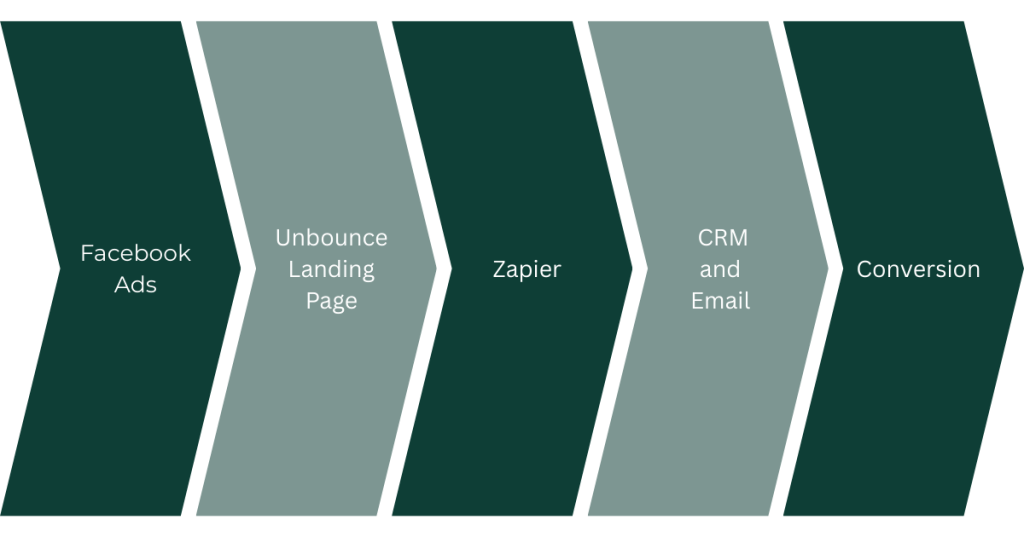
1. Attracting Visitors
The funnel started with Facebook Ads to generate awareness and drive traffic. These campaigns were A/B tested for messaging and visuals, ensuring that the ads resonated with the right audience segments.
2. Capturing Leads
Instead of sending traffic to a generic homepage, clicks were routed to Unbounce landing pages. Each page was tailored to a specific audience or offer, with clear calls-to-action and forms built to maximize conversion. A/B testing allowed for continuous optimization where different headlines, images, and button text were tested and refined.
3. Automating the Flow
Once someone filled out a form, Zapier stepped in. This simple but powerful automation tool acted as the “traffic cop”, instantly sending the data to:
- Emma (to start the email nurture sequence).
- HubSpot CRM (for sales tracking and lead management).
- Or, when applicable, Gravity Forms on WordPress sites for direct integration.
This meant no manual copying, pasting, or delays in following up. Every lead was automatically logged, tagged, and nurtured.
4. Nurturing Leads with Email
The email sequence inside Emma had three tiers:
- Immediate confirmation: A tailored welcome email that acknowledged the sign-up and set expectations.
- Nurture emails: Educational resources, testimonials, and helpful content designed to build trust and credibility.
- CTA emails: Timely, action-oriented emails encouraging sign-ups, calls, or offers.
This balance kept the communication warm, not pushy, while still nudging leads closer to conversion.
The Outcome
The result was a self-sustaining lead engine that combined paid ads, smart landing pages, and automated workflows.
- 🚀 Increased conversion rates thanks to A/B testing and tailored messaging.
- ⏱️ Time savings of over 15 hours a month of manual follow-up was eliminated.
- 🔁 A repeatable system that could scale up or down depending on campaign needs.
While I can’t share specific numbers, the impact was clear: more leads, less busywork, and a marketing process that felt both automated and human at the same time.
Why This Matters
Marketing automation is sometimes seen as “cold” or impersonal. My takeaway from this project is that automation doesn’t replace the human touch, but rather, it amplifies it. By removing the repetitive, manual work, bandwidth is freed up to focus on creating authentic, meaningful interactions with your audience.
The right combination of tools can transform campaigns into well oiled engines that run smoothly in the background while you focus on strategy, creativity, and connection.
This project reinforced an important lesson for me: smart systems scale impact without scaling workload. Whether you run a small business or a larger organization, blending automation with personalization is the key to growth.
If you’re looking to build a similar system, start simple: Pick one channel, one landing page, and one automation. Get that working, then expand. With platforms like Facebook Ads, Unbounce, Emma, Zapier, HubSpot, and Gravity Forms, the possibilities are endless and the payoff is worth it.


 TANGIE BODDEN
Leave a comment